
You’ve probably already tried taking a deep breath when anxiety hits, hoping it would be enough to settle your racing heart. But a single breath rarely stops a spiraling mind or a pounding chest – grounding requires more targeted techniques that work with your nervous system, not just around it.
In this guide, we’ll explain exactly what grounding is, why it works, and which techniques to use depending on your situation.
Key Takeaways
- Grounding is a set of coping techniques that redirect attention to the present moment using physical sensation, the five senses, or focused thought to reduce anxiety, panic, or dissociation.
- Anxiety disorders affect an estimated 34% of the U.S. population, yet only about 25% of affected individuals receive treatment – Source: Koniver, Medical Research Archives, 2024.
- Grounding techniques work by activating the parasympathetic nervous system, which slows the heart rate and counteracts the body’s stress response.
- Grounding methods generally fall into three categories: sensory, physical, and mental techniques, each suited to different situations.
- The 5-4-3-2-1 technique is one of the most widely used grounding methods, engaging sight, touch, hearing, smell, and taste in sequence.
- Practicing grounding regularly, not just during moments of crisis, strengthens your ability to use it effectively under stress.
- Grounding is a complementary self-regulation tool and does not replace professional treatment for severe or persistent anxiety, PTSD, or dissociative disorders.
What Is Grounding?
Grounding is a set of coping techniques that redirect your attention to the present moment using physical sensation, the five senses, or focused thought to reduce anxiety, panic, or dissociation.
At its core, grounding interrupts a spiraling thought pattern by giving your brain something concrete to focus on instead.
For example, pressing your feet firmly into the floor and naming what you feel – the texture of your socks, the pressure of the ground pulls your attention away from anxious thoughts and back into your body.
This is different from general relaxation, which aims to lower overall tension, or mindfulness meditation, which trains sustained, non-judgmental awareness over time.
Grounding is faster and more targeted: it’s designed to work in the middle of a spike in anxiety, not just as a long-term practice.
Grounding techniques are also distinct from simply “calming down.” As such, they don’t ask you to suppress or fight your emotions; they ask you to anchor yourself in something real and immediate while the emotional wave passes. For more on this distinction, read our guide on “difference between anxiety and stress”.
Read Also: Self Love Affirmations That Actually Work | Perfect Guide
Where Grounding Comes From
Grounding techniques originated in trauma therapy and cognitive-behavioral treatment, where clinicians needed fast, reliable tools to help clients experiencing flashbacks or dissociation.
Over time, therapists adapted these same techniques for everyday anxiety, panic attacks, and general stress management. Today, grounding shows up everywhere from clinical PTSD treatment to classroom stress-reduction programs, which speaks to how flexible and accessible the techniques really are.
Why Does Grounding Matter?
Grounding matters because it gives your nervous system a fast, reliable off-ramp from the fight-or-flight response before anxiety spirals into a full panic attack.
Anxiety disorders affect approximately 34% of the U.S. population, making them one of the most common mental health challenges people face – Source: Koniver, Medical Research Archives, 2024.
At the same time, access to treatment remains limited, with only about 25% of people with anxiety disorders receiving care.
That gap is exactly why self-directed tools like grounding matter so much. Grounding techniques work by activating the parasympathetic nervous system, which slows the heart rate, lowers blood pressure, and counteracts the body’s stress response.
For example, slow diaphragmatic breathing signals safety to your brainstem, which then dials down the adrenaline driving your panic. To understand the biology behind this, read our guide on “nervous system regulation explained”.
Moreover, grounding is especially useful for people managing more than everyday stress. A 2024 quasi-experimental study found that psychoeducation combined with grounding techniques led to a significant reduction in anxiety among adolescents following a structured training program – Source: Journal of Social Work and Science Education, 2025.
In addition, grounding is frequently used alongside trauma-focused therapy to help people with PTSD manage flashbacks and dissociative episodes, since it interrupts the body’s alarm response before it fully takes over. If you’re unsure whether what you’re experiencing is a panic attack, read our guide on “signs of a panic attack”.
What Are the Different Types of Grounding Techniques?
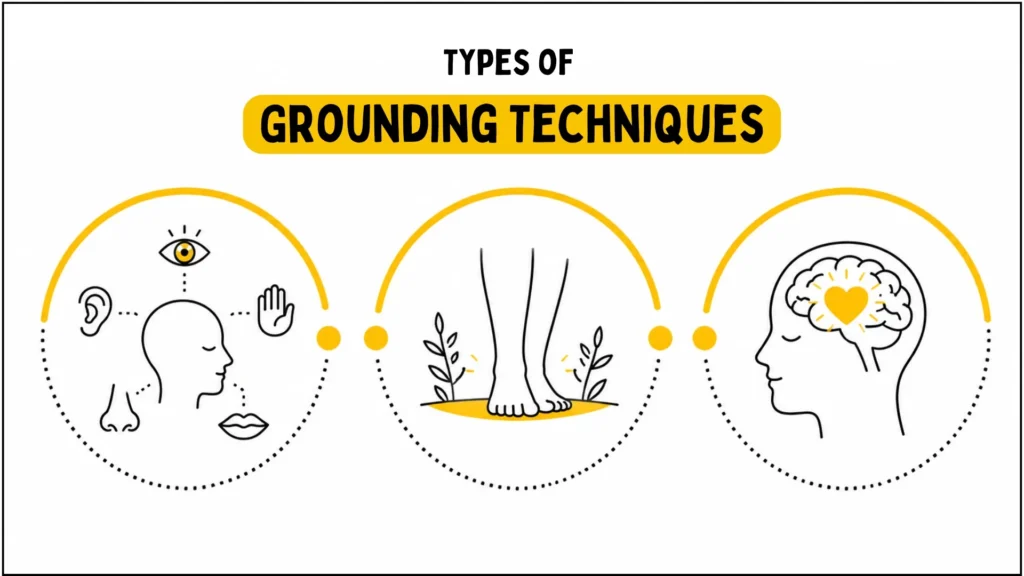
Grounding techniques generally fall into three categories: sensory grounding, physical grounding, and mental grounding. Each category uses a different pathway- your senses, your body, or your thoughts to bring your attention back to the present.
Sensory Grounding Techniques
Sensory grounding uses your five senses sight, touch, hearing, smell, and taste to anchor you in the present moment. For example, holding an ice cube, smelling a strong scent like peppermint, or focusing intently on a single object in the room are all sensory techniques that work almost immediately.
Physical Grounding Techniques
Physical grounding uses movement or bodily sensation to shift your nervous system out of high alert. For example, pressing your palms together, stretching your arms overhead, or practicing progressive muscle relaxation, tensing and releasing muscle groups one at a time, can quickly reduce physical tension.
A 2024 systematic review of 46 studies across 16 countries, covering more than 3,400 adults, found that progressive muscle relaxation effectively reduces stress, anxiety, and depression – Source: systematic review cited in Looking Glass NYC, 2024.
👉Read Also: The Universe Sends You Healing While You Sleep. Are You Listening?
Mental Grounding Techniques
Mental grounding uses focused thought or categorization tasks to occupy the anxious part of your brain. For example, counting backward from 100 by sevens, naming every state you can think of, or silently reciting the steps of a familiar recipe all require enough concentration to crowd out spiraling thoughts.
To explore related coping strategies, read our guide on “coping strategies for dissociation”.
| Grounding Type | Best For | Example Technique | Time to Work |
|---|---|---|---|
| Sensory | Panic attacks, sudden spikes | 5-4-3-2-1 technique | 1–3 minutes |
| Physical | Chronic tension, restlessness | Progressive muscle relaxation | 3–10 minutes |
| Mental | Racing thoughts, dissociation | Category counting | 1–5 minutes |
[Insert image: Simple diagram showing the three grounding categories with icons | Alt text: “Compare sensory, physical, and mental grounding techniques”]
What Is the 5-4-3-2-1 Grounding Technique?
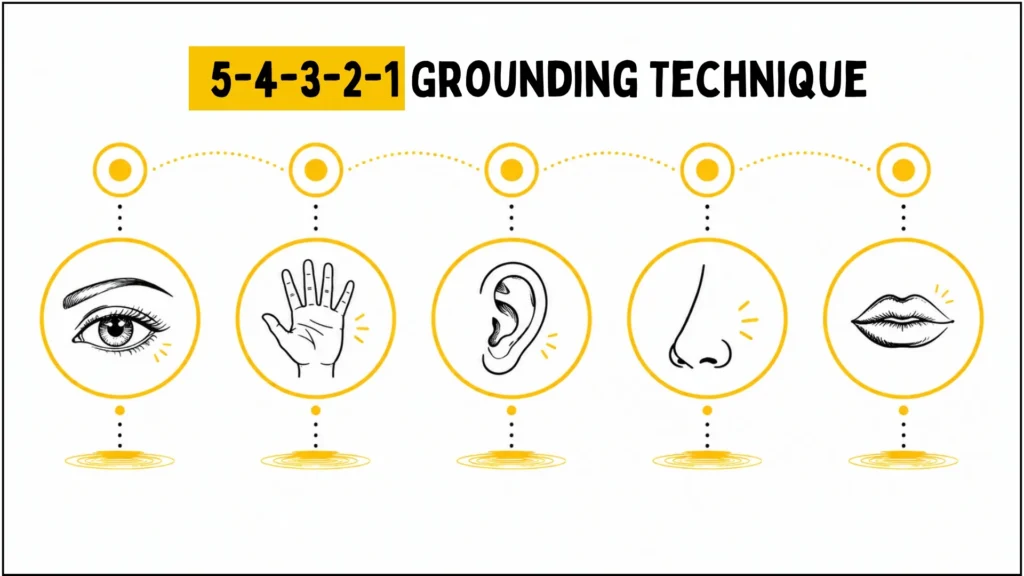
The 5-4-3-2-1 grounding technique involves identifying five things you can see, four things you can touch, three things you can hear, two things you can smell, and one thing you can taste. This sequence walks you through all five senses in a structured order, which makes it easy to remember even when you’re anxious.
First, look around and silently name five things you can see – a window, a chair, a pattern on the wall. Second, notice four things you can physically touch, such as your clothing, a desk, or your own hands. Third, listen for three distinct sounds, like traffic, a fan, or your own breathing.
Fourth, identify two things you can smell, even faint ones like coffee or fresh air. Finally, name one thing you can taste, whether it’s toothpaste, gum, or simply the inside of your mouth. For a deeper breakdown of this method, read our guide on the “5-4-3-2-1 grounding technique,” a dedicated sensory grounding technique guide.
How Do You Ground Yourself During a Panic Attack?
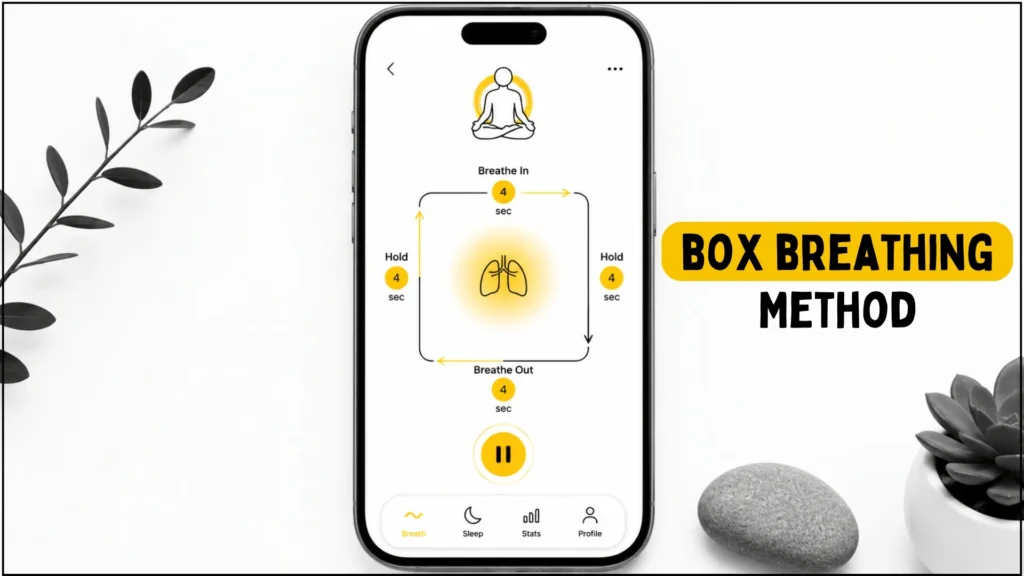
You ground yourself during a panic attack by combining a physical anchor with slow, controlled breathing to interrupt the body’s fight-or-flight response. First, plant both feet firmly on the ground and press down, noticing the pressure and stability beneath you. This physical anchor gives your brain a concrete signal that you are safe and stationary.
Second, pair this with box breathing: inhale for four counts, hold for four counts, exhale for four counts, and hold again for four counts.
For example, someone feeling a panic attack building before a meeting might step into a quiet hallway, plant their feet, and run through two or three rounds of box breathing before returning.
To explore more breathing-based methods, read our guide on “box breathing exercises”. Third, once your breathing slows, layer in a quick sensory check, naming a few things you can see or touch to fully bring your attention back to the room.
Can Grounding Techniques Help With Dissociation?
Yes, grounding techniques can help with dissociation by re-anchoring your attention in your body and immediate surroundings when you feel disconnected or unreal.
Dissociation often involves a sense of watching yourself from outside your body, or feeling like the world isn’t quite real, and grounding directly counters that by emphasizing concrete sensory input.
For example, someone experiencing dissociation might hold a textured object, like a stress ball or a piece of fabric, and describe its texture out loud in detail. This kind of specific, sensory-focused language pulls attention back into the present.
That being said, if dissociation happens frequently or severely disrupts daily life, grounding should be used alongside professional support rather than as a standalone fix.
What Are the Best Grounding Exercises for Beginners?
The best grounding exercises for beginners are simple, low-effort techniques that don’t require any equipment or practice to get started. Beginners tend to have the most success with the 5-4-3-2-1 technique, deep belly breathing, and the “cold water” method: briefly running cold water over your hands or splashing your face.
Plus, beginners benefit from starting with just one or two techniques rather than trying to memorize a long list. As such, pick one sensory technique and one breathing technique, and practice both a few times when you’re calm so they’re familiar before you actually need them under stress.
Read Also: Spiritual Awakening Signs: What You’re Really Experiencing
How Long Does It Take for Grounding Techniques to Work?

Most grounding techniques begin to reduce anxiety within one to five minutes, though the exact timing depends on the technique and the intensity of the anxiety. Sensory techniques like the 5-4-3-2-1 method tend to work fastest, often producing a noticeable shift within one to three minutes.
Physical techniques like progressive muscle relaxation may take slightly longer, typically three to ten minutes, since they involve working through multiple muscle groups. As such, it helps to think of grounding as a process rather than an instant fix a gradual dial-down rather than an off switch.
What Objects or Tools Can Help With Grounding?
Several everyday objects and tools can make grounding techniques easier to access in the moment, including textured objects, cold water, weighted blankets, and grounding apps.
First, a small textured item a smooth stone, a piece of fabric, or a stress ball gives you something tactile to focus on anywhere you go.
Second, cold water, whether from a tap or a chilled water bottle, triggers a fast physiological calming response.
Third, weighted blankets provide deep pressure input that some people find calming for both anxiety and sleep.
Fourth, grounding and mindfulness apps offer guided audio walkthroughs for people who find it easier to follow a voice than to remember steps on their own. Read our full roundup of “best anxiety relief apps” to compare free and paid options.
Is Grounding the Same as Mindfulness or Meditation?
No, grounding is not the same as mindfulness or meditation, though the three practices overlap and often work well together. Grounding is typically a short, targeted response to acute anxiety or distress, while mindfulness and meditation are broader practices aimed at building sustained present-moment awareness over time.
For example, a 10-minute seated meditation practiced daily builds long-term resilience to stress, while a 5-4-3-2-1 grounding exercise is something you’d use in the middle of a panic spike at your desk. If you’re new to the broader practice, read our guide on “mindfulness meditation for beginners” to see how the two approaches complement each other.
Tools and Practical Applications for Grounding
Beyond individual objects, several categories of tools can support a consistent grounding practice. You can build a simple “grounding kit” in a small pouch containing a textured object, a mint or other strong-smelling item, and a card listing your go-to steps.
You can also use free breathing and grounding apps that offer guided timers for techniques like box breathing. Plus, several free tools exist alongside paid options; many meditation and breathing apps offer a free tier that includes basic grounding exercises, which is worth exploring before paying for a premium subscription.
For workplaces, schools, or clinical settings, printed grounding scripts or laminated cards can be kept on hand so the steps are available without needing a phone. This can benefit teachers, coaches, and caregivers who want a low-tech option to guide someone else through a grounding exercise.
👉 Read Also: How to Write a Manifestation Journal: Step-by-Step Guide
What’s Next: Building a Personal Grounding Routine
By practicing grounding techniques when you’re calm, you can build the muscle memory needed to use them effectively when anxiety actually strikes. First, pick two or three techniques from the categories above: one sensory, one physical, one mental, and practice each for a few minutes daily, even when you don’t feel anxious.
Second, identify your personal early-warning signs of rising anxiety, such as a tight chest or racing thoughts, so you know exactly when to start grounding rather than waiting until you’re in a full panic.
Third, build grounding into transitions in your day before a stressful meeting, after checking the news, or before bed so it becomes a habit rather than just an emergency tool. To build a broader foundation, read our guide on “how to build a self-care routine”.
That being said, grounding is a complementary self-regulation tool and does not replace professional treatment for severe or persistent anxiety, PTSD, or dissociative disorders.
If anxiety is interfering with your daily life, work, or relationships, it’s worth exploring “when to see a therapist for anxiety” alongside your grounding practice.
Conclusion
Grounding gives you a fast, science-backed way to interrupt anxiety, panic, and dissociation by anchoring your attention in the present moment through your senses, body, or mind.
Whether you reach for the 5-4-3-2-1 technique, a round of box breathing, or a simple cold-water splash, the goal is the same: give your nervous system a clear, concrete signal that it’s safe to stand down.
Start small: pick one technique from this guide, practice it today, and let it become the tool you reach for the next time anxiety shows up.
FAQ’s About How to Ground Yourself
1. What does it mean to “ground yourself”?
A. Grounding yourself means using a sensory, physical, or mental technique to redirect your attention to the present moment and calm your nervous system.
2. Is grounding effective for panic attacks?
A. Yes, grounding is widely used as a fast-acting technique to interrupt the physical symptoms of a panic attack, particularly when combined with slow breathing.
3. Can children use grounding techniques?
A. Yes, simplified versions of grounding techniques, like naming favorite colors or animals, are commonly used with children to manage anxiety and big emotions.
4. Do I need any special equipment for grounding?
A. No, most grounding techniques require no equipment at all, though some people find tools like textured objects or cold water helpful.
5. How often should I practice grounding?
A. Practicing grounding daily, even briefly, helps build familiarity so the techniques come more naturally during moments of actual anxiety.

I’m Joe, the voice behind this blog. I write about signs, thoughts, and moments that don’t feel random. Simple things that somehow seem to carry a deeper meaning. This space is for anyone who feels there’s more to life than what we see on the surface. Through articles on spirituality, self-discovery, manifestation, and personal growth, I aim to help readers explore the messages, patterns, and connections that may be guiding their journey.