
Why Binaural Beats Help You Relax Faster Than Music
You’ve tried sleep playlists. You’ve tried white noise. Maybe even ocean waves. But your mind still races the moment your head hits the pillow.
Here’s something most people don’t know: your brain has its own electrical rhythm, and you can tune it like a radio station. That’s exactly what binaural beats do, and science has something very interesting to say about it.
Binaural beats are not music. They’re an auditory experience that gently guides your brain into a state of deep relaxation, sometimes faster than any playlist ever could. In this article, you’ll find out why they work, how they compare to music for sleep, and whether they’re worth adding to your nighttime routine.
Table of Contents
What Are Binaural Beats, and Why Does Your Brain React to Them?
Binaural beats work by playing two slightly different sound frequencies in each ear, and your brain does something remarkable with them.
When you hear a tone of 200 Hz in your left ear and 210 Hz in your right ear, your brain perceives a third tone at the difference: 10 Hz. This imagined third tone is called a binaural beat. Your brain doesn’t just hear it; it begins to synchronize with it.
This process is called brainwave entrainment. Research published in Frontiers in Human Neuroscience has found that the brain’s electrical activity tends to follow external rhythmic stimuli, a phenomenon well-documented in neuroscience.
Here’s why that matters for sleep: different mental states are linked to specific brainwave frequencies. Delta waves (0.5–4 Hz) dominate deep sleep. Theta waves (4–8 Hz) appear during light sleep and meditation. Binaural beats in those ranges can gently nudge your brain toward those states without pills, without effort.
👉 Related Article: Sound Healing Benefits Explained
How Do Binaural Beats Compare to Regular Music for Sleep?
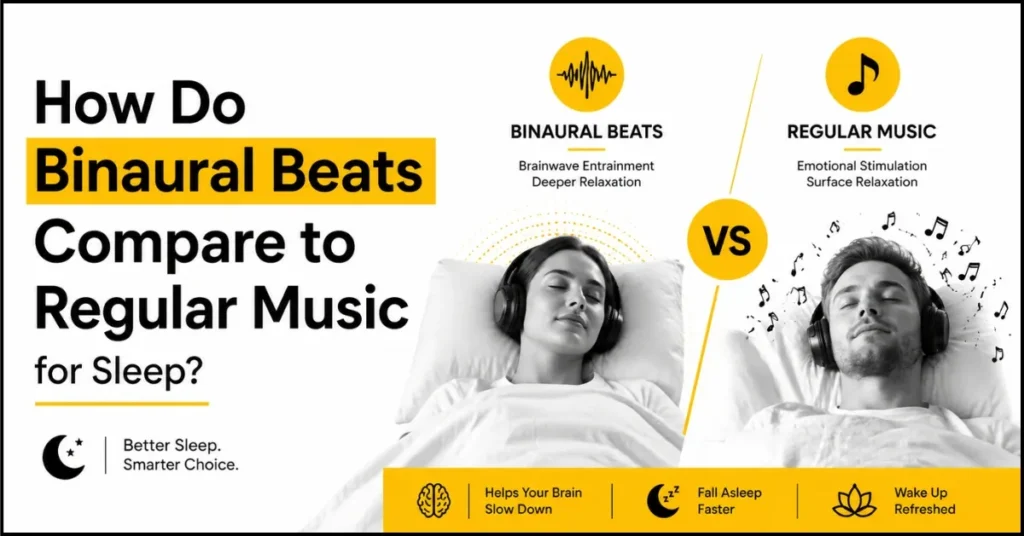
Music can relax you. Binaural beats can change your brain state. That distinction is important.
When you listen to calming music, your nervous system responds emotionally. Your heart rate may slow, your breathing deepens, and you feel less tense. But your brainwaves don’t necessarily shift into sleep-ready territory.
Binaural beats work differently. They target the brain’s electrical frequencies directly. Think of it this way:
- Music works on your emotions and body
- Binaural beats work on your brain’s operating frequency
A 2019 study published in PLOS ONE found that binaural beats in the delta and theta range significantly reduced anxiety and improved pre-sleep relaxation in adult participants. Music alone did not show the same measurable brainwave changes.
That said, both have their place. Many people use binaural beats layered with calm ambient music for a combined effect. The key advantage of binaural beats is that they create a neurological response, not just an emotional one.
What Science Says About Binaural Beats Benefits for Sleep
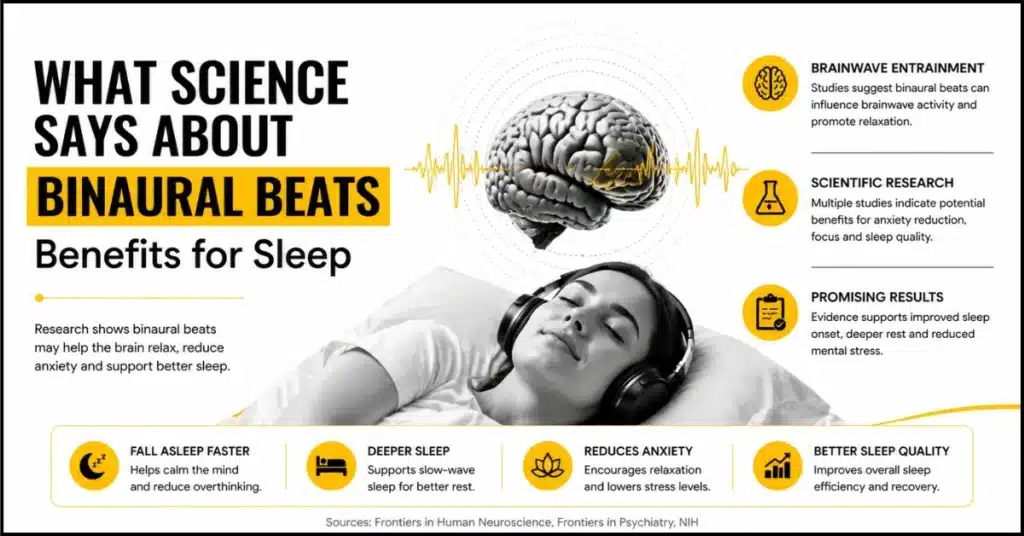
Research on the benefits of binaural beats for sleep is still growing, but the early findings are genuinely interesting.
Delta frequency beats (0.5–4 Hz)
These are associated with deep, restorative sleep. Studies suggest that listening to delta binaural beats before bed may help reduce the time it takes to fall asleep and improve sleep quality.
Theta frequency beats (4–8 Hz)
These are linked to the drowsy, meditative state just before sleep, sometimes called hypnagogia. Many users report feeling deeply relaxed and mentally quiet after just 15–20 minutes of theta beats.
Alpha frequency beats (8–12 Hz)
These are connected to calm wakefulness and stress reduction. These are useful for winding down in the evening without feeling groggy.
👉 Related Article: Why Listening to 432 Hz Frequency Feels So Calming
Key factual insights from research and credentialed sources:
- The Monroe Institute, a pioneer in binaural beat research, has documented brainwave entrainment effects since the 1970s.
- A study in the Journal of Alternative and Complementary Medicine found that binaural beats reduced pre-operative anxiety significantly compared to control groups.
- The National Institutes of Health (NIH) has indexed multiple peer-reviewed studies examining binaural beat effects on sleep, mood, and cognition.
- Dr. Gerald Oster’s 1973 paper in Scientific American was one of the first to formally describe binaural beating as a measurable auditory phenomenon in the brain.
- Research from Applied Psychophysiology and Biofeedback suggests that theta binaural beats may enhance mental relaxation and reduce mind-wandering, a common barrier to sleep onset.
Who Can Benefit Most From Binaural Beats for Sleep?
Not everyone struggles with sleep the same way. Binaural beats tend to be most helpful for specific types of sleepers.
People with racing minds – If your brain is still problem-solving at 11 PM, theta beats can interrupt that mental loop and steer you toward quieter thought patterns.
Light sleepers and those with stress-related insomnia – Delta beats used during sleep may support longer deep sleep phases.
Meditators and mindfulness practitioners – Binaural beats are already widely used in meditation communities. The sleep transition feels natural for those already familiar with the practice.
People who find music too stimulating – Even calming music can hold attention and prevent sleep. Pure binaural tones are more passive and demand nothing from your mind.
Those dealing with chronic sleep disorders should consult a medical professional. Binaural beats are a complementary tool, not a clinical treatment.
How to Use Binaural Beats Effectively for Sleep
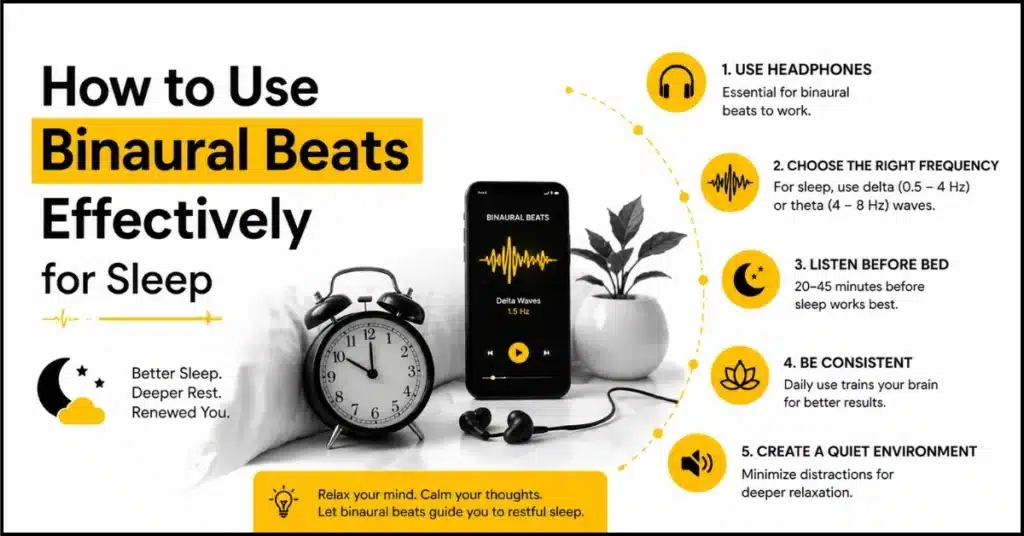
Getting results from binaural beats requires more than just pressing play. A few simple practices make a big difference.
Use stereo headphones. This is non-negotiable. Binaural beats require each ear to receive a different frequency. Speakers merge the sounds before they reach your brain, eliminating the effect entirely.
Choose the right frequency for your goal:
- Delta (0.5–4 Hz) – for deep sleep
- Theta (4–8 Hz) – for pre-sleep relaxation and light sleep
- Alpha (8–12 Hz) – for evening wind-down and stress relief
Listen for at least 15–30 minutes. Brainwave entrainment takes time. Short sessions may not produce noticeable effects.
Reduce distractions. Dim your lights, put away your phone, and let the experience guide you. Binaural beats work best when you give your brain the space to follow them.
Be consistent. Like most sleep hygiene habits, binaural beats tend to work better over time. Many users report more pronounced results after a week of nightly use.
👉 Related Article: Listening to the Same Sound Daily Can Change You
Binaural Beats Risks or Side Effects?
Binaural beats are considered safe for most adults, but a few precautions are worth knowing.
People with epilepsy or seizure disorders should avoid them, as rhythmic auditory stimulation may pose a risk. Those with pacemakers or other electronic implants should consult a doctor first.
Some users report mild headaches or dizziness during their first few sessions. This typically fades as the brain adapts to the experience.
Binaural beats should not replace professional treatment for diagnosed sleep disorders, anxiety disorders, or depression. They are best used as a relaxation support tool alongside healthy sleep habits.
Final Thoughts: Should You Try Binaural Beats for Sleep?
If you’ve tried everything else and still find yourself lying awake with a busy brain, binaural beats are worth a genuine test. They cost nothing to try — free tracks are available on YouTube and Spotify — and the potential benefit is real.
Your brain wants to sleep. Sometimes it just needs a gentle nudge in the right direction. And these quiet, almost invisible sounds might be exactly that nudge.
Start with a 30-minute theta beat session tonight, headphones on, lights off. You might be surprised how fast your mind goes quiet.
FAQ’s About Binaural Beats Benefits for Sleep
1. Do binaural beats actually work for sleep?
A. Yes, there is growing scientific support for their effectiveness. Multiple peer-reviewed studies have found that binaural beats at delta and theta frequencies can reduce sleep-onset time and improve relaxation before bed. Results vary by individual, but many consistent users report meaningful improvements in sleep quality.
2. How long does it take for binaural beats to work?
A. Most people begin to notice relaxation within 10 to 20 minutes of listening. For stronger effects like improved sleep quality over time, consistent nightly use over 7 to 14 days tends to produce the most noticeable results.
3. Can you listen to binaural beats while sleeping?
A. Yes, many people fall asleep while listening to binaural beats, and that’s perfectly fine. Some choose to use a timer to stop playback after 30 to 60 minutes so the audio doesn’t continue all night. Comfortable, low-profile earbuds designed for sleep are widely available.
4. What frequency is best for deep sleep?
A. Delta waves in the 0.5 to 4 Hz range are most closely linked to deep, restorative sleep. Theta waves (4 to 8 Hz) are better for the pre-sleep wind-down phase. Starting with theta beats and transitioning to delta is a common approach.
5. Are binaural beats safe to use every night?
A. For most healthy adults, daily use is considered safe. There are no known risks to routine listening. However, those with epilepsy, seizure disorders, or certain neurological conditions should consult a healthcare provider before using binaural beats.
6. Do you need headphones for binaural beats?
A. Yes. Headphones are essential. The entire mechanism depends on each ear receiving a slightly different frequency. Without headphones, the two tones merge before reaching the brain, and the binaural beat effect is lost entirely.
7. Can binaural beats replace sleep medication?
A. No. Binaural beats are a relaxation and sleep support tool, not a medical treatment. Anyone using prescription sleep medication should not discontinue it without consulting a doctor. Binaural beats can complement good sleep hygiene practices, but are not a substitute for professional
Disclaimer
This article is for informational purposes only and does not constitute medical advice. Binaural beats are not a clinically proven treatment for sleep disorders, anxiety, or any medical condition. Individuals with epilepsy, seizure disorders, pacemakers, or other serious health conditions should consult a licensed healthcare provider before using binaural beat audio. Always maintain good sleep hygiene practices and seek professional guidance for persistent sleep problems.

I’m Joe, the voice behind this blog. I write about signs, thoughts, and moments that don’t feel random. Simple things that somehow seem to carry a deeper meaning. This space is for anyone who feels there’s more to life than what we see on the surface. Through articles on spirituality, self-discovery, manifestation, and personal growth, I aim to help readers explore the messages, patterns, and connections that may be guiding their journey.
This resonates so much with what you’re sharing about theta and delta frequencies – I’ve noticed the same thing with sleep-onset time when I’m consistent with binaural work. I’ve been exploring http://www.quantress.com lately, which personalizes the frequency layers based on your archetype, and it’s deepened how I approach my evening wind-down routine. Have you found that certain frequency ranges work better for you than others, or does it vary based on your day’s energy?