
You wake up exhausted. Relationships feel stuck. Your chest feels tight with emotions you cannot name. What if the answer is not in your medicine cabinet but in the invisible energy flowing through you right now?
Chakra healing is the ancient practice of restoring balance to your body’s seven primary energy centers. When these centers flow freely, life feels lighter. When they are blocked, everything from your health to your emotions to your relationships can feel off. This guide will show you exactly what the chakras are, why they matter, and how to start healing them today.
Table of Contents
What Is Chakra Healing, Really?
Chakra healing is the practice of clearing, activating, and balancing the seven energy centers in the human body. These centers govern your physical, emotional, and spiritual well-being.
The word “chakra” comes from Sanskrit and translates to “wheel” or “disc.” The concept originates in ancient Hindu and Vedic texts, some of which date back over 3,000 years. The Vedas, among the oldest spiritual scriptures known to humanity, describe the body as a living energy system with invisible channels called nadis through which life force energy flows.
Fact: The concept of chakras appears in some of the earliest written records of human civilization. The Rigveda, a sacred Hindu text estimated to be from around 1500 BCE, contains early references to energy centers and life force known as prana.
From the perspective of the universe and the spiritual law of attraction, your energy does not just stay inside you. It radiates outward. When your chakras are balanced, you naturally attract health, abundance, and fulfilling connections. When they are blocked, you may unknowingly repel the very things you desire most.
Energy healing traditions, including chakra work, exist in many world cultures. Traditional Chinese Medicine refers to similar energy pathways as meridians. The concept of life force energy also appears in Japanese healing as “ki,” in ancient Egyptian traditions, and in Indigenous healing practices around the world.
👉 Read Also: 21 Powerful Signs the Universe Is Trying to Tell You Something
What Are the 7 Chakras and What Do They Control?
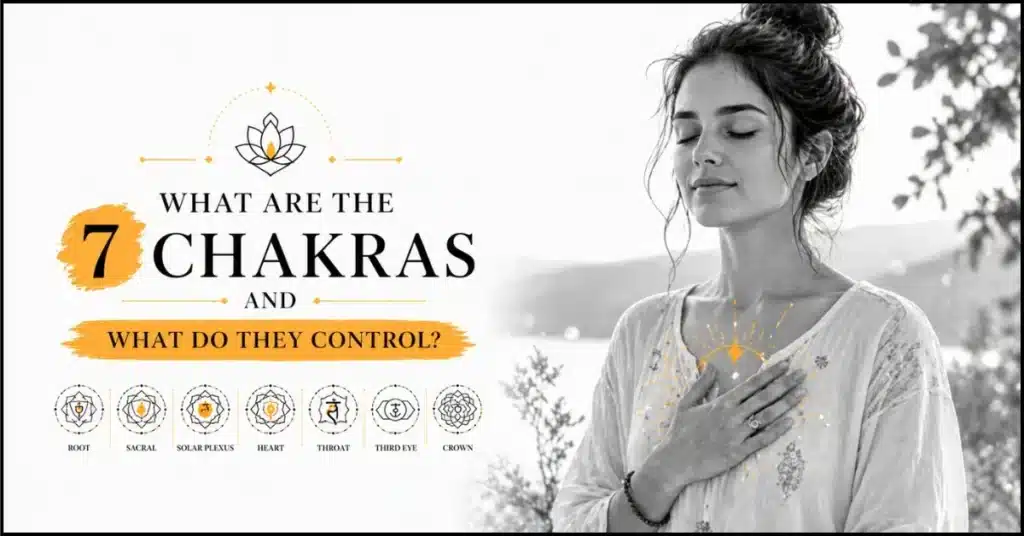
Each of the seven main chakras corresponds to a specific area of the body, a color, an element, and a domain of life. Understanding each one helps you pinpoint where healing is most needed.
| Chakra | Location | Color | Life Domain |
|---|---|---|---|
| Root (Muladhara) | Base of spine | Red | Safety, grounding, survival |
| Sacral (Svadhisthana) | Lower abdomen | Orange | Creativity, sexuality, emotion |
| Solar Plexus (Manipura) | Upper abdomen | Yellow | Confidence, willpower, identity |
| Heart (Anahata) | Center of chest | Green | Love, compassion, connection |
| Throat (Vishuddha) | Throat | Blue | Communication, truth, expression |
| Third Eye (Ajna) | Between eyebrows | Indigo | Intuition, clarity, wisdom |
| Crown (Sahasrara) | Top of the head | Violet / White | Spiritual connection, divine purpose |
Think of these seven centers as a ladder connecting earth energy to universal energy. The lower chakras deal with your physical and emotional world. The upper chakras connect you to higher consciousness and spiritual awareness. A truly balanced life means energy moves freely from bottom to top.
How Do You Know If Your Chakras Are Blocked?
1. Root Chakra (Muladhara) | Red | Base of Spine | Earth Element | Safety & Survival
Chronic fear, financial anxiety, feeling disconnected from your body, lower back pain, and a constant sense of being unsafe. If you always feel like the ground could fall away at any moment, this is the chakra to address first.
Signs of imbalance:
- Constant financial worry
- Lower back or leg pain
- Feeling ungrounded or scattered
- Hoarding or overspending
- Fear of change or instability
- Digestive issues, constipation
Fact: Research published in medical literature consistently links chronic stress and anxiety to physical tension in the lower spine and pelvis, the same region associated with the root chakra in Vedic tradition.
Quick healing tip: Walk barefoot on grass or soil for 10 minutes daily. Physical contact with the earth activates and grounds this energy center.
👉 Read Also: Sound Healing Benefits Explained: How Frequencies Affect Your Mind
2. Sacral Chakra (Svadhisthana) | Orange | Lower Abdomen | Water Element | Creativity & Emotion
When the sacral chakra is blocked, your creative energy feels dry, and your emotional life feels either numb or overwhelming. This is the center of pleasure, sensuality, and the ability to flow with life rather than resist it.
Signs of imbalance:
- Creative blocks or apathy
- Emotional numbness or outbursts
- Low libido or intimacy fears
- Hip tightness, pelvic tension
- Guilt around pleasure or joy
- Difficulty adapting to change
Fact: The sacral chakra governs the reproductive organs and kidneys in the Vedic system. Studies on the mind-body connection consistently show that suppressed emotions correlate with tension held in the hips and lower abdominal region.
Quick healing tip: Spend time near or in water. Swimming, taking a bath, or simply sitting beside a river can begin to unlock the flow of sacral energy.
3. Solar Plexus Chakra (Manipura) | Yellow | Upper Abdomen | Fire Element | Willpower & Identity
The solar plexus is your personal power center. When blocked, you may feel like a passenger in your own life, unable to set boundaries or assert your needs. An overactive solar plexus can swing into controlling, aggressive behavior.
Signs of imbalance:
- Low self-esteem or confidence
- Inability to say no
- Stomach issues or acid reflux
- Feeling powerless or victimized
- Need to control others
- Procrastination, lack of drive
Fact: The solar plexus region houses the celiac plexus, one of the largest nerve networks in the body. This is why emotional stress so commonly manifests as a “gut punch” feeling, a phenomenon studied extensively in psychosomatic medicine.
Quick healing tip: Spend time in direct sunlight, placing your awareness on your upper abdomen. Breathwork exercises like Kapalabhati (breath of fire) are traditional tools for igniting this center.
4. Heart Chakra (Anahata) | Green | Center of Chest | Air Element | Love & Compassion
Difficulty giving or receiving love. Holding onto old grudges. Feeling emotionally guarded or easily hurt. The heart chakra is the bridge between the lower physical chakras and the upper spiritual ones. When it is blocked, you feel cut off from both yourself and others.
Signs of imbalance:
- Inability to forgive
- Fear of intimacy or vulnerability
- Chest tightness or shallow breath
- Codependency or isolation
- Grief that will not move through
- Jealousy or resentment
Fact: Research from the HeartMath Institute has found that the heart generates an electromagnetic field extending several feet from the body, the largest of any organ. This aligns with the long-held spiritual view that the heart radiates energy beyond the physical body.
Quick healing tip: Practice loving-kindness meditation (metta). Silently send the phrase “may you be happy, may you be at peace” first to yourself, then to others. This directly activates heart chakra energy.
5. Throat Chakra (Vishuddha) | Blue | Throat | Space Element | Truth & Expression
Struggling to say what you truly feel. Fear of speaking in public. Saying yes when you mean no. Frequent throat issues or tension in the neck. Your throat chakra is your channel of authentic expression, and when it is blocked, your truth stays locked inside.
Signs of imbalance:
- Fear of speaking your truth
- Chronic sore throat or neck pain
- Talking excessively or not enough
- Difficulty asking for help
- Thyroid imbalances
- Feeling unheard or misunderstood
Fact: The throat is home to the thyroid gland, which regulates metabolism and energy. Endocrinologists note that thyroid disorders are disproportionately common in people who suppress emotion and experience chronic communication-related stress.
Quick healing tip: Journaling, singing, chanting, or even humming stimulates the vagus nerve and activates the throat chakra. The bija mantra for this chakra is HAM. Chant it softly and feel the vibration in your throat.
6. Third Eye Chakra (Ajna) | Indigo | Between Eyebrows | Light Element | Intuition & Wisdom
When the third eye is blocked, you lose trust in your own inner knowing. You feel confused, mentally foggy, and disconnected from your intuition. You may overthink every decision or feel spiritually disconnected from the larger meaning of your life.
Signs of imbalance:
- Chronic indecision
- Headaches or eye strain
- Dismissing gut feelings
- Mental fog or poor memory
- Nightmares or poor sleep
- Closed-mindedness or cynicism
Fact: The third eye chakra is associated with the pineal gland in many spiritual traditions. The pineal gland produces melatonin and has been found in scientific research to respond directly to light, regulating sleep, mood, and circadian rhythms. Descartes famously called it “the seat of the soul.”
Quick healing tip: Spend time in silent observation before reacting to any situation. Meditation focused on the space between the brows for even 5 minutes daily sharpens intuitive perception over time.
👉 Read Also: Spiritual Meaning of Turtle: What the Universe Is Telling You
7. Crown Chakra (Sahasrara) | Violet / White | Top of the Head | Cosmic Element | Spiritual Connection
A blocked crown chakra creates a deep sense of spiritual isolation. You may feel that life is meaningless, that you are alone in the universe, or that no higher power or purpose is guiding you. When open, the crown chakra is where you experience oneness, divine grace, and profound peace.
Signs of imbalance:
- Feeling spiritually disconnected
- Existential emptiness or despair
- Migraines or scalp sensitivity
- Rigid or dogmatic thinking
- Inability to experience awe or wonder
- Materialism as the only reality
Fact: Studies on meditation and prayer consistently show activation of the prefrontal cortex and changes in default mode network activity, regions of the brain associated with self-transcendence and a sense of universal connection. Neuroscientist Andrew Newberg has documented these “neurotheology” findings over two decades of research.
Quick healing tip: Spend time in silent gratitude, looking at the night sky or sitting in open nature. The crown chakra opens most naturally when the ego quiets and you allow yourself to feel part of something greater. The mantra AUM (OM) is its traditional sound.
What Are the Most Effective Chakra Healing Techniques?
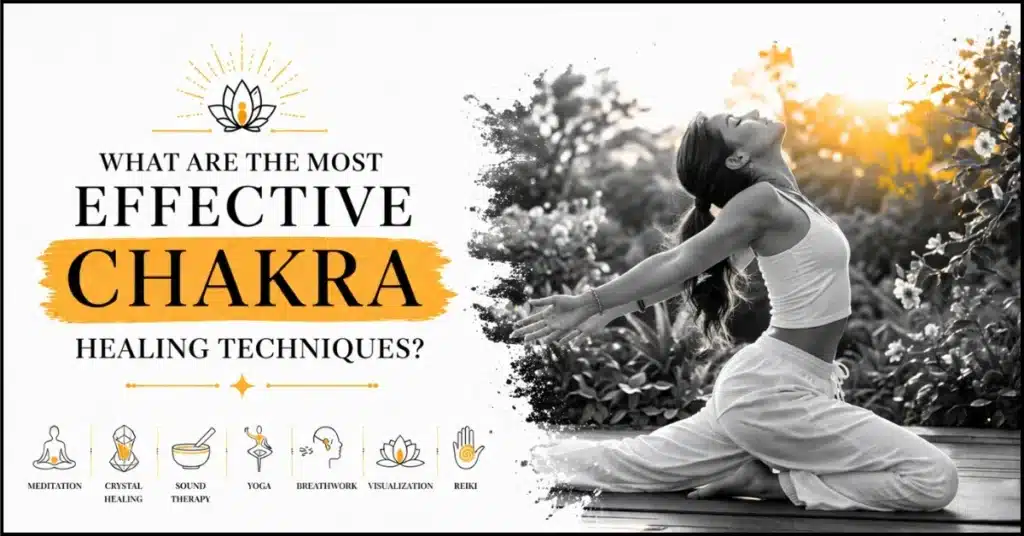
Chakra healing is not one-size-fits-all. Different practices work for different people and different blockages. The most powerful approach is one you can stay consistent with.
1. Meditation and breathwork
Focused meditation is one of the most researched and widely recommended tools for energy healing. Directing your breath and attention to a specific chakra point while visualizing its corresponding color can activate and clear that center. Even 10 minutes a day creates real change over time.
Fact: A 2018 study published in Frontiers in Human Neuroscience found that mindfulness meditation significantly altered brain activity in regions linked to emotional regulation, self-awareness, and body awareness. These are the same functions associated with chakra balance in traditional systems.
2. Sound healing and mantras
Each chakra resonates with a specific vibrational frequency. Seed mantras (bija mantras) such as LAM for the root chakra or AUM for the crown chakra are used in traditional Vedic practice to activate these centers. Sound bowls tuned to specific frequencies serve a similar purpose in modern healing spaces.
Fact: The use of sound in healing is cross-cultural and ancient. Tibetan singing bowls have been used in Himalayan cultures for centuries as tools for meditation and spiritual healing, according to records documented by cultural historians and anthropologists.
3. Crystals and gemstone healing
Different crystals are believed to carry specific vibrational energies that align with the seven chakras. Red jasper and black tourmaline for the root chakra. Rose quartz for the heart. Amethyst for the crown. Placing these stones on the corresponding body area during meditation deepens the healing experience for many practitioners.
4. Yoga and body movement
Specific yoga poses target and activate individual chakras. Child’s pose grounds and opens the root chakra. Camel pose opens the heart. The shoulder stand activates the throat. Yoga connects breath, body, and awareness, making it one of the most complete forms of chakra healing available.
Fact: Yoga originated in India over 5,000 years ago, with its roots in the same Vedic tradition that gave rise to the chakra system. Today, the World Health Organization recognizes yoga as a complementary health approach practiced by hundreds of millions worldwide.
5. Nature immersion and elemental healing
The universe communicates through nature. Walking barefoot on soil grounds the root chakra. Swimming in natural water activates the sacral chakra. Sitting in sunlight energizes the solar plexus. Fire ceremonies have been used for millennia to burn away what no longer serves us. Nature is not separate from your energy. It is a living part of it.
Fact: A landmark 2019 study published in Scientific Reports found that spending at least 120 minutes per week in nature was strongly associated with greater health and well-being. Researchers from the University of Exeter analyzed data from nearly 20,000 participants to reach this conclusion.
👉 Read Also: Angel Numbers Meaning: What the Universe Is Telling You
How Does Chakra Healing Connect to the Law of Attraction?

Your chakras are your energetic broadcast signal. The law of attraction responds to what you radiate, not just what you think. Unblocked chakras allow you to send and receive high-frequency energy with clarity.
When your root chakra is blocked, you vibrate at a frequency of fear and scarcity. No amount of positive thinking can fully override that underlying energy signal. When it is open, you naturally radiate safety and trust, which brings aligned opportunities into your field.
The heart chakra is particularly powerful in the context of manifestation. Spiritual teachers across many traditions agree that love is the highest vibrational frequency. Opening the heart chakra does not just improve your relationships. It elevates the entire frequency of your energy field, which in turn affects what you attract.
The crown chakra represents your direct connection to universal consciousness. When open, many practitioners report a profound sense of divine guidance, clarity about their life purpose, and a feeling of being genuinely supported by the universe.
Chakra healing and the law of attraction are not separate systems. There are two ways of understanding the same truth: your inner energy shapes your outer experience. When you heal from the inside out, your outer world begins to reflect that healing back to you.
Can Chakra Healing Be Part of a Holistic Wellness Routine?
Yes. Chakra healing works best when woven into daily life rather than practiced as an occasional ritual. Small, consistent energy practices build powerful cumulative change.
A simple daily chakra wellness routine might look like this:
- Morning: 5 minutes of grounding breath to activate the root chakra
- Midday: A few minutes in sunlight, placing awareness on your solar plexus
- Evening: A short body scan meditation moving attention through all seven chakras
- Weekly: A longer yoga session focused on the chakra areas that feel most blocked
- Monthly: A sound bath, a Reiki session, or nature immersion for deeper clearing
Fact: The National Center for Complementary and Integrative Health (NCCIH), part of the U.S. National Institutes of Health, recognizes energy-based practices, including meditation, yoga, and bodywork, as complementary health approaches with growing bodies of research supporting their benefits for stress reduction and overall wellness.
What Does Research Say About Energy Healing Practices?
While the specific concept of chakras is rooted in spiritual tradition rather than Western science, many of the practices used in chakra healing have been studied and show measurable benefits for mental and physical health.
Meditation, yoga, breathwork, sound therapy, and nature immersion are all components of chakra healing that have been studied in clinical settings. The results consistently point to measurable reductions in cortisol (the stress hormone), improvements in heart rate variability, and positive changes in markers of inflammation.
Fact: A systematic review published in JAMA Internal Medicine analyzed 47 clinical trials involving mindfulness meditation programs and found moderate evidence for improvement in anxiety, depression, and pain. The researchers noted the practice’s potential as part of a comprehensive wellness approach.
From a spiritual perspective, these physical measurements may simply be evidence of what energy healers have always known: when the energy flows, the body and mind naturally begin to heal.
👉 Read Also: Why Listening to 432 Hz Frequency Feels So Calming
Start Your Chakra Healing Journey Today
You do not need to overhaul your entire life to begin. Start with one chakra. Sit quietly, place your hand on the area of your body that corresponds to it, breathe deeply, and simply notice what you feel. That act of conscious attention is already healing.
The universe is not withholding anything from you. It is responding, always, to the energy you carry. Chakra healing is not about becoming a different person. It is about removing what is covering the light that was always there.
Your energy is your greatest asset. Invest in it with the same care you give to your body and your mind. The returns are extraordinary.
FAQ’s About Chakra Healing
1. How long does it take for chakra healing to work?
A. There is no single timeline. Some people feel a shift after one deep meditation session. For others, clearing longstanding blocks requires weeks or months of consistent practice. The key is showing up regularly, even for just a few minutes each day. Energy responds to intention and attention over time.
2. Can blocked chakras cause physical illness?
A. In spiritual and energy healing traditions, blocked chakras are believed to contribute to physical symptoms. For example, a blocked throat chakra is often linked to thyroid issues, and a blocked heart chakra to respiratory problems. While this is a spiritual framework rather than a medical diagnosis, many holistic health practitioners use chakra mapping as one lens among several to understand a patient’s well-being.
3. Do I need a practitioner for chakra healing, or can I do it myself?
A. You absolutely can practice chakra healing on your own. Meditation, yoga, breathwork, journaling, and spending time in nature are all self-directed practices. That said, working with a trained Reiki practitioner, sound healer, or energy therapist can accelerate the process, especially for deep or longstanding blockages.
4. Which chakra should I heal first?
A. Most energy healers recommend starting from the ground up, beginning with the root chakra. A stable, grounded foundation makes it easier to do the deeper work of the upper chakras. That said, you can also follow your intuition and focus on the chakra area where you feel the most tension, emotion, or physical sensation.
5. Is chakra healing connected to any specific religion?
A. Chakra healing originates in Hindu and Vedic tradition, but it is practiced today by people of all spiritual backgrounds and none at all. Many practitioners approach it as a secular wellness practice, similar to yoga and meditation, which have similarly transcended their religious origins to become global health tools.
6. What is the difference between chakra healing and Reiki?
A. Reiki is a Japanese energy healing practice that works with universal life energy (ki) to promote healing and relaxation. Chakra healing specifically focuses on the seven energy centers of the body. The two are complementary and are often practiced together. A Reiki session will frequently include chakra balancing as part of the treatment.
Disclaimer: This article is intended for informational and spiritual wellness purposes only. Chakra healing is a complementary practice rooted in ancient spiritual tradition and is not a substitute for professional medical advice, diagnosis, or treatment. If you are experiencing physical or mental health concerns, please consult a qualified healthcare provider. The factual claims in this article are drawn from publicly available research and reputable sources, and are presented to provide context, not to make therapeutic claims.

I’m Joe, the voice behind this blog. I write about signs, thoughts, and moments that don’t feel random. Simple things that somehow seem to carry a deeper meaning. This space is for anyone who feels there’s more to life than what we see on the surface. Through articles on spirituality, self-discovery, manifestation, and personal growth, I aim to help readers explore the messages, patterns, and connections that may be guiding their journey.