
Something changed. You used to look forward to plans, group hangouts, and long phone calls. Now you find yourself making excuses to stay home, and honestly? It feels good.
You are not antisocial. You are not depressed. You might just be shifting into a new version of yourself.
Millions of people go through a phase where they suddenly prefer being alone, and most of them never fully understand why. This article breaks it down in plain, honest language because you deserve more than a generic “it’s okay to be introverted” pep talk.
Table of Contents
What Does It Actually Mean to Prefer Being Alone?
Preferring solitude does not mean you hate people. It means your nervous system and emotional needs have changed, even if temporarily.
Psychologists distinguish between two types of alone-time preferences. The first is chosen solitude, a healthy, deliberate decision to recharge. The second is social withdrawal, which can signal depression, anxiety, or burnout. Most people who say they prefer being alone are experiencing the first type, not the second.
According to research published in the British Journal of Psychology, people who spend time alone by choice report higher levels of creativity, emotional processing, and self-awareness than those who avoid solitude altogether.
👉 Related Articles: Why Do I Feel Disconnected From Everyone?
Why You Suddenly Prefer Being Alone: 8 Real Reasons
1. Your Brain Is Overstimulated and Desperately Needs Rest
Modern life is a constant stream of notifications, opinions, noise, and demands. When the brain hits its stimulation limit, it craves quiet.
This is not a weakness. It is neuroscience.
The human brain, specifically the prefrontal cortex, can only process so much social information before it begins to fatigue. Social interaction requires constant emotional reading, verbal processing, and behavioral adjustment. Solitude gives the brain permission to stop performing.
If you have been around a lot of people recently, or if your job involves constant communication, your preference for being alone right now is your brain asking for a basic biological need.
2. You Are Going Through an Internal Transformation
Sometimes you pull away from others because something inside you is changing, and that process demands privacy.
Big internal shifts, new values, a changing identity, and the ending of a chapter often happen quietly and alone. You cannot always explain what is happening to the people around you, so you stop trying. You go inward.
This is one of the most overlooked reasons people prefer being alone. You are not running away from life. You are running toward a deeper version of yourself.
Psychologist Carl Jung called this process individuation, the lifelong journey of becoming who you truly are, separate from the roles others assign you.
3. You Have Been Emotionally Drained by Someone (Or Many People)
Not all relationships replenish you. Some leave you feeling empty.
If someone in your life, a partner, a friend, a family member, or even a coworker, consistently takes more than they give, your mind starts associating “people” with “exhaustion.” You begin to protect your energy by pulling back.
This is not permanent bitterness. This is self-preservation.
Emotional labor is real and documented. Research from the University of Michigan found that emotionally demanding interactions significantly reduce a person’s capacity for further social engagement, sometimes for days at a time.
4. You Are Healing From Something You Have Not Fully Processed
Grief, trauma, disappointment, and heartbreak all have one thing in common: they require internal space to move through.
When you are hurting in a way you cannot explain to others, solitude becomes a sanctuary. You are not shutting people out. You are creating a safe container for healing that does not require justification.
Solitude during healing is not isolation; it is incubation.
👉 Related Articles: Why Do I Suddenly Feel Sad and Cry for No Reason
5. Your Social Circle No Longer Reflects Who You Are
You may prefer being alone because the people available to you are not the people you actually want to be around.
This is more common than most people admit. As people grow, their values shift. Conversations that used to feel exciting start to feel hollow. And instead of pretending to enjoy those interactions, your instinct is to simply opt out.
This does not make you arrogant or cold. It makes you self-aware.
6. You Are an Introvert Who Has Been Ignoring Your Own Nature
Some people spend years performing extroversion because it was expected of them at school, at work, and in relationships.
If you are an introvert, your brain is literally wired differently. Research from Harvard Medical School using neuroimaging found that introverts have higher baseline activity in areas associated with internal thought and reflection, while extroverts have more activity in areas tied to sensory processing and reward from social stimulation.
Preferring to be alone is not a personality flaw. For introverts, it is a biological default.
7. You Have Found Peace in Your Own Company
Here is a reason people rarely admit out loud: you have started to genuinely enjoy yourself.
When you become comfortable with your own thoughts, humor, creativity, and silence, other people start to feel like interruptions. Not because you dislike them, but because you have discovered something most people spend decades searching for: the ability to be your own best company.
This is one of the healthiest reasons to prefer being alone, and it deserves to be celebrated rather than questioned.
8. Anxiety or Depression May Be Playing a Role
This point deserves honesty. Sometimes the preference for solitude is not a choice; it is a symptom.
Social anxiety can make even casual interactions feel threatening. Depression can flatten the desire for connection entirely. If your preference for being alone comes with persistent sadness, loss of interest in things you used to love, or a feeling of hopelessness, please consider speaking to a mental health professional.
There is a meaningful difference between choosing solitude and hiding from life. Only you can honestly assess which one is happening.
👉 Related Articles: Why Your Manifestation Feels Blocked (And How to Fix It Fast)
Is Preferring to Be Alone a Sign of Intelligence?
Research suggests there may be a link. But it is more nuanced than a simple yes.
A 2016 study published in the British Journal of Psychology found that highly intelligent individuals reported lower life satisfaction when they spent more time socializing than they preferred. For people with busy, high-functioning minds, frequent social interaction can actually get in the way of the deep thinking and creative processing they find most fulfilling.
This does not mean introverts are smarter. It means people who prefer solitude often have rich inner lives that social environments interrupt rather than enhance.
The Difference Between Healthy Solitude and Unhealthy Isolation
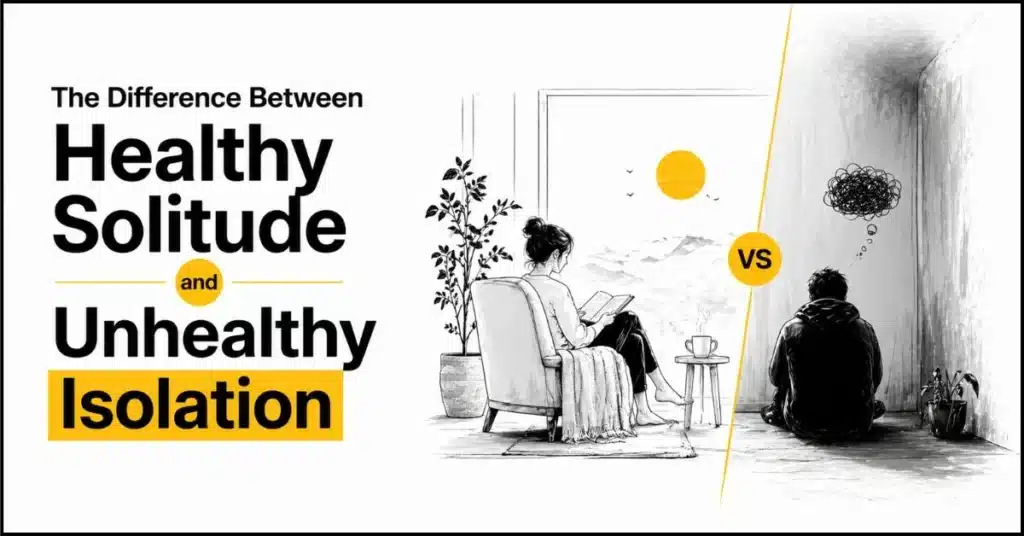
Not all alone time is created equal. Here is how to tell the difference.
Healthy solitude looks like:
- Choosing time alone to recharge, create, or reflect
- Enjoying your own company without anxiety
- Feeling refreshed after time alone and open to connection when ready
- Maintaining some relationships, even if fewer or less frequent
Unhealthy isolation looks like:
- Avoiding people because social situations cause panic or dread
- Feeling lonely but unable to reach out
- Withdrawing because you believe you do not deserve a connection
- Using alone time to ruminate, catastrophize, or escape reality entirely
The key question is this: Does your alone time make you feel more like yourself, or less?
What Science Says About the Benefits of Solitude
Solitude is not just socially acceptable: it is scientifically beneficial.
- A study from the University of Rochester found that people who regularly spend time alone report greater emotional regulation and clarity in decision-making.
- According to Harvard neuroscientist Shelley Carson, solitude enhances creative cognition by allowing the brain’s default mode network (associated with imagination and self-reflection) to activate fully.
- The American Psychological Association notes that voluntary solitude is linked to increased mindfulness, reduced stress and cortisol levels, and improved self-concept clarity.
- Research on adolescents published in the Journal of Research on Adolescence found that teens who regularly chose solitude had better emotional health outcomes than those who rarely spent time alone.
These are not small findings. They reflect a growing scientific consensus: solitude, chosen freely, is a cornerstone of psychological well-being.
How to Honor Your Need for Alone Time Without Hurting Your Relationships
Wanting to be alone does not have to mean abandoning everyone around you. It just requires honest communication and intentional boundaries.
Be honest without over-explaining. You do not owe people a long justification for needing space. “I need some time to myself this weekend” is a complete sentence.
Schedule solitude like an appointment. Give it the same respect you would give a commitment to another person. Block the time. Protect it.
Check in with yourself regularly. Ask: Am I choosing solitude, or am I hiding? Both deserve attention, but they require different responses.
Stay gently connected. A short message, a brief check-in, or a low-energy hangout once in a while keeps relationships alive without draining your reserves.
👉 Related Articles: 7 Signs Your Manifestation Is Closer Than You Think (How to Know It’s Working)
When Preferring to Be Alone Becomes a Problem
There is a point where healthy solitude tips into something that deserves attention.
Watch for these signs:
- You have not spoken to anyone outside your household in weeks
- You feel relief when plans are cancelled, followed immediately by loneliness
- You are using alone time to avoid rather than to rest
- Your relationships are deteriorating, and you feel indifferent about it
- Physical symptoms like fatigue, poor sleep, or appetite changes accompany your withdrawal
If several of these resonate, it may be time to speak to a therapist or counselor. Preferring solitude is healthy. Losing your capacity for connection is not.
Final Thoughts
If you suddenly prefer being alone, the most important thing to understand is this: you are not broken, cold, or antisocial. You are listening to something your mind and body are telling you.
Whether it is overstimulation, emotional healing, personal growth, or simply the discovery that you enjoy your own company, your need for solitude deserves respect. Not an apology.
The world will always have more noise. Your ability to choose quiet is one of the most underrated forms of self-care you have.
Honor it. Understand it. And trust that when you are ready to reconnect with others, or with a new version of yourself, you will know.
FAQ’s About Why You Suddenly Prefer Being Alone
1. Is it normal to suddenly prefer being alone?
A. Yes, it’s completely normal. People naturally go through phases where they need more space. Stress, life changes, or personal growth can all make you crave solitude. It only becomes a concern if it comes with ongoing sadness or affects your daily life.
2. Does preferring to be alone mean I am depressed?
A. Not necessarily. Wanting alone time isn’t the same as depression. Depression usually includes low mood, lack of interest, and fatigue. If your solitude feels more like escape than rest, it might be worth talking to someone.
3. Can preferring solitude be a good thing?
A. Yes, it can be very positive. Alone time can boost creativity, reduce stress, and help you understand yourself better. Many people do their best thinking when they’re alone.
4. Why do I feel drained around people now when I didn’t before?
A. This is common, especially after stress or emotional changes. Your social energy can shift over time. Feeling drained usually means you need rest, not that something is wrong with you.
5. How much alone time is too much?
A. There’s no fixed rule. It depends on how it makes you feel. If you feel refreshed, it’s healthy. If you start feeling more isolated or low over time, it might be too much.
6. Is preferring to be alone a sign of introversion?
A. Sometimes, but not always. Introverts naturally recharge alone, but anyone can want more solitude during certain phases. It doesn’t automatically define your personality.
Disclaimer: This article is intended for general informational purposes only and does not constitute medical or psychological advice. If you are experiencing persistent feelings of loneliness, depression, or anxiety, please consult a licensed mental health professional.

I’m Joe, the voice behind this blog. I write about signs, thoughts, and moments that don’t feel random. Simple things that somehow seem to carry a deeper meaning. This space is for anyone who feels there’s more to life than what we see on the surface. Through articles on spirituality, self-discovery, manifestation, and personal growth, I aim to help readers explore the messages, patterns, and connections that may be guiding their journey.