
Here’s something most parents don’t realize: the words your child speaks every single day are quietly building their reality. Not just their mood for the morning. Their reality.
The universe is always listening. Energy flows where attention goes. And for a child still discovering who they are, the words they repeat become beliefs, and those beliefs become their life.
Positive affirmations for kids are one of the most gentle, powerful, and spiritually grounded tools you can give your child. And the best part? It takes less than five minutes a day.
Table of Contents
What Are Positive Affirmations for Kids?
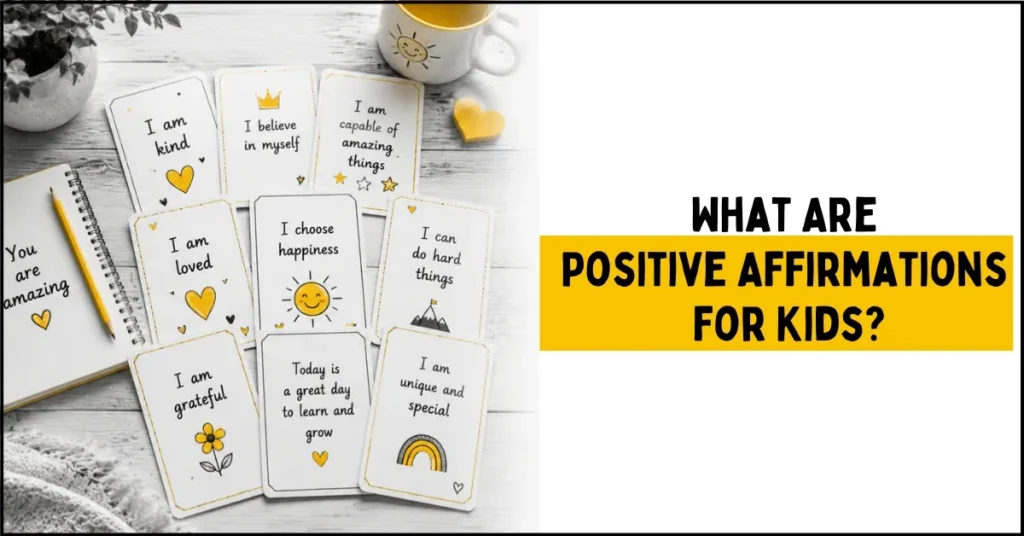
Positive affirmations for kids are short, uplifting statements that children repeat to themselves to build confidence, calm anxiety, and shift their mindset toward love and possibility.
Think of them as seeds. Each time your child says “I am loved,” “I am brave,” or “I belong here,” they are planting something beautiful inside their mind and energy field.
From a law of attraction perspective, our thoughts and words send vibrations into the universe. Children, who are naturally closer to pure creative energy, respond to this practice quickly and deeply.
According to research linked to the American Psychological Association, self-affirmation practices activate the brain’s reward centers and reduce defensive responses to stress. This is not just spiritual belief; this is science confirming what ancient wisdom already knew.
👉 Read Also: Affirmations for Inner Peace That Actually Work Daily
Why Do Affirmations Work So Well for Children?
Children’s brains are more open and receptive than adult brains. Before the age of 7, children operate primarily in a brain wave state called Theta, the same state adults enter during deep meditation. This means young children absorb what they hear and say as pure truth.
When a child repeatedly hears and speaks positive statements, those words bypass the critical conscious filter that adults have and go straight into the subconscious mind. That is exactly where lasting change happens.
A 2016 study from Carnegie Mellon University found that self-affirmation significantly reduced the stress responses of participants facing difficult challenges. When applied to children early, this builds emotional resilience that lasts a lifetime.
How Do Positive Affirmations Connect to the Law of Attraction?
The law of attraction is simple: like attracts like. What we focus on, we draw more of into our experience.
When a child repeatedly says, “I am enough,” they begin to feel enough. When they feel enough, they act from a place of confidence. When they act confidently, the world around them responds differently. That cycle is the law of attraction in real life.
Nature itself teaches this principle. Trees that grow toward the light become stronger and taller. A child whose thoughts are directed toward love, worth, and possibility will naturally grow in that same direction.
Morning Affirmations for Kids: The Best Time to Plant the Seed
Morning is the most powerful time for affirmations. After sleep, the mind is naturally in a lighter brain wave state, closer to Theta and Alpha, and more receptive to new programming. Starting your child’s day with spoken affirmations is like watering a garden right after a rain. The soil is soft. The seeds go deep.
- “I am loved, and I am safe.”
- “Today is going to be a great day.”
- “I am smart, and I can figure things out.”
- “I am brave enough to try new things.”
- “Good things are always coming to me.”
- “I choose to be happy today.”
- “I am kind, and my kindness makes the world better.”
Encourage your child to say these while looking in the mirror. Eye contact with one’s own reflection amplifies the emotional impact and helps the words land deeper.
👉 Read Also: Nighttime Affirmations: How to Reprogram Your Subconscious Mind While You Sleep
Healing Affirmations for Kids: When Your Child Needs Extra Love
Sometimes children carry pain they cannot yet name. Anxiety. Loneliness. The heavy feeling that they don’t belong. Healing affirmations speak directly to the heart, reminding the body and spirit that they are whole, worthy, and held by something greater than their current fear.
- “My feelings are okay. I am safe to feel them.”
- “I am healing, and every day I feel a little better.”
- “The universe is on my side.”
- “I am surrounded by love even when I don’t see it.”
- “I release what hurts me. I welcome what helps me.”
- “Nature is healing me. The earth supports me.”
These are especially powerful when spoken in nature. Let your child stand barefoot on grass, close their eyes, breathe deeply, and say these words. The energy of the earth amplifies the healing intention.
Confidence Affirmations for Kids Who Struggle With Self-Doubt
Many children carry a quiet inner voice that says, “I’m not good enough” or “nobody likes me.” Left unchallenged, these beliefs grow into patterns that follow them into adulthood. Confidence affirmations interrupt that pattern gently and consistently.
- “I am good at things, and I keep getting better.”
- “I believe in myself.”
- “My voice matters, and people want to hear it.”
- “I am a great friend.”
- “Mistakes are how I learn. I am not afraid to try.”
- “I am proud of who I am becoming.”
Research from Stanford psychologist Carol Dweck shows that children who believe their abilities can grow perform significantly better academically and socially. These affirmations directly support that growth mindset.
Nature-Based Affirmations That Connect Kids to Universal Energy

Nature is one of the most powerful healing forces available to children. Many spiritual traditions recognize that children who feel connected to the natural world develop stronger emotional regulation, deeper empathy, and a clearer sense of purpose.
- “I am as strong as a tree.”
- “Like the sun, I bring light to everyone around me.”
- “The earth loves me, and I love the earth.”
- “I am part of something beautiful and big.”
- “Like water, I can flow around any obstacle.”
- “The stars are always watching over me.”
How to Create a Daily Affirmation Routine That Kids Actually Love
Consistency is everything. A single affirmation said once does almost nothing. The same affirmation said daily for weeks rewires the nervous system. Here is a simple, joyful routine that actually works:
1. Wake-up mirror moment: Each morning, stand with your child in front of the mirror and say 3 to 5 affirmations together out loud. Keep it short, keep it fun.
2. Bedtime heart-hand ritual: Before sleep, have your child place both hands on their heart, take 3 deep breaths, and whisper 2 to 3 affirmations. This plant’s seeds right before the brain enters deep processing sleep.
3. Affirmation cards in their space: Write affirmations on colorful cards and place them on the bathroom mirror, fridge, or in their backpack where they’ll see them daily.
4. Nature affirmation walks: Once a week, take a short walk in nature and let your child pick one affirmation to repeat quietly with each step. Movement, breath, and intention together create a deeply grounding experience.
👉 Read Also: 111 Angel Number: Not a Coincidence, Not a Glitch, Something Bigger
Age-Specific Positive Affirmations for Kids
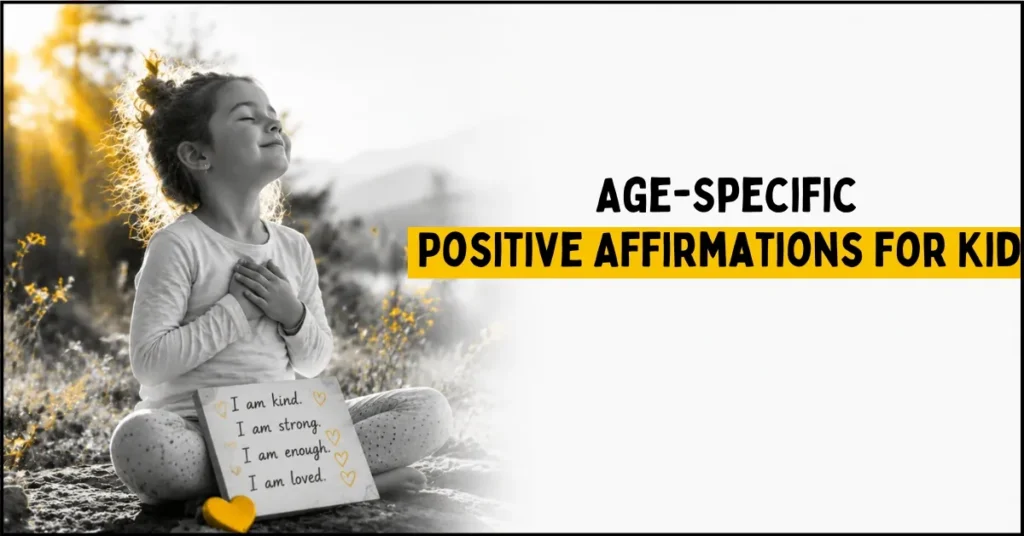
Not all affirmations work the same way for every age group. Here is a quick guide:
1. Ages 3–6
- “I am loved.”
- “I am happy.”
- “I am safe.”
- “Today is a good day.”
- “I am magical.”
2. Ages 7–10
- “I am smart, and I love learning.”
- “I have good friends, and I am a good friend.”
- “I can do hard things.”
- “I matter.”
3. Ages 11–14
- “I am becoming exactly who I am meant to be.”
- “I don’t need to be perfect to be worthy.”
- “My differences make me powerful.”
- “I trust myself.”
5 Factual Insights to Know About Affirmations and Children
- Neuroplasticity is most active in childhood. The brain physically reshapes itself based on repeated thoughts and experiences. Positive affirmations literally help build new, healthy neural pathways.
- The American Academy of Pediatrics recognizes that a child’s sense of self and emotional security is deeply influenced by repeated verbal messaging in their environment.
- Studies on mindfulness and self-talk in children show that those who practice positive inner dialogue report lower levels of anxiety and higher academic engagement.
- Dr. Masaru Emoto’s water crystal research proposed that words and intentions can influence molecular structure. Given that children’s bodies are approximately 75% water, this offers an intriguing lens on the power of spoken words.
- Indigenous healing traditions across multiple cultures, from Native American to Aboriginal Australian, have long used spoken word ceremonies as a core practice for nurturing children’s spiritual identity and emotional strength.
Final Thoughts: You Are Raising a Child the Universe Believes In
Every child born into this world arrives as pure potential. Pure energy. Pure light.
What they hear, what they believe, and what they say about themselves becomes the architecture of their inner world. And that inner world shapes everything they experience on the outside.
Positive affirmations for kids are not just a parenting tool. They are an act of love. A spiritual practice. A daily reminder to your child that they are worthy of good things, capable of great things, and supported by a universe that wants them to thrive.
Start small. Start today. Even one loving sentence spoken with intention can plant a seed that grows for a lifetime.
The universe is listening. And so is your child.
FAQ’s About Positive Affirmations for Kids
1. Do positive affirmations actually work for kids?
A. Yes, and there is both research and real-world evidence to support this. Studies on neuroplasticity, self-affirmation, and mindset development all show that repeated positive self-talk reshapes how children think, feel, and respond to challenges. From a spiritual perspective, affirmations also help children align their inner energy with love, confidence, and possibility.
2. At what age should I start affirmations with my child?
A. You can begin as early as age 2 or 3 with the simplest statements like “I am loved” and “I am safe.” Children’s brains are incredibly receptive to language from birth onward. The earlier you begin, the more natural the habit becomes.
3. How often should kids do affirmations?
A. Daily is ideal. Even 2 to 3 minutes in the morning and before bed creates a consistent practice. The repetition over days and weeks is what creates real change in the brain and energy field.
4. What if my child resists or thinks affirmations are silly?
A. Make it playful. Use funny voices. Turn it into a game. Let them pick their own affirmations. Children resist what feels forced, but embrace what feels fun and loving. Lead by example and say your own affirmations alongside them.
5. Can affirmations help kids with anxiety?
A. Yes. Research shows that positive self-affirmation reduces the brain’s threat response and helps children feel safer and more capable. Healing affirmations combined with deep breathing and nature time create a powerful, gentle anxiety relief practice.
6. Are affirmations connected to spirituality?
A. They can be, but they don’t have to be. Affirmations work on a purely psychological level through neuroplasticity and mindset. For families who embrace a spiritual worldview, they also serve as a practice of co-creation with the universe and alignment with higher energy. You can approach them from whichever angle feels right for your family.
Disclaimer: This article is written from a spiritual and holistic wellness perspective. The affirmations and practices shared here are meant to support emotional well-being and positive mindset development. They are not a substitute for professional mental health care. If your child is experiencing significant emotional or behavioral challenges, please consult a qualified child psychologist or healthcare provider.

I’m Joe, the voice behind this blog. I write about signs, thoughts, and moments that don’t feel random. Simple things that somehow seem to carry a deeper meaning. This space is for anyone who feels there’s more to life than what we see on the surface. Through articles on spirituality, self-discovery, manifestation, and personal growth, I aim to help readers explore the messages, patterns, and connections that may be guiding their journey.