
You may have noticed butterflies appearing everywhere lately, whether in your backyard, during walks, or at moments that feel surprisingly meaningful. While many people dismiss these encounters as coincidence, others believe they carry a deeper message.
In this guide, you’ll discover the spiritual symbolism, psychological explanations, and practical ways to interpret the meaning behind why you keep seeing butterflies.
Key Takeaways
- Repeated butterfly sightings can hold personal, spiritual, or psychological significance depending on your beliefs and current life circumstances.
- Butterfly symbolism is commonly associated with transformation, hope, renewal, and personal growth across many cultures and spiritual traditions.
- Psychological factors, such as selective attention, can explain why butterflies seem to appear more often once you start noticing them.
- Butterfly colors are often interpreted differently, with white representing peace, yellow symbolizing hope, and black suggesting transformation.
- Personal reflection is generally the most meaningful way to interpret recurring encounters with butterflies in your own life.
- Journaling your sightings may reveal emotional or life patterns worth paying attention to.
- A balanced perspective considers both symbolic meaning and natural, environmental explanations side by side.
What Does It Mean When You Keep Seeing Butterflies?
Seeing butterflies repeatedly generally means one of three things: a spiritual sign, a psychological pattern, or a natural coincidence tied to your environment.
First, many spiritual traditions treat butterflies as messengers of transformation, hope, and renewal, especially during periods of major life change.
At the same time, psychologists point to attention-based explanations, since the brain is wired to notice things it has recently become emotionally invested in. As such, the “right” interpretation usually depends on what’s happening in your life when the sightings start.

For example, someone who recently lost a parent may notice a butterfly landing near them during a walk and feel an immediate sense of connection to that loss.
Someone else going through a career change might see a caterpillar-to-butterfly video shared online and then start spotting real butterflies constantly for the following week. Both experiences are valid, even though one leans spiritual and the other leans psychological.
Recurring butterfly encounters are best understood as a pattern worth reflecting on, not a mystery that needs a single definitive answer.
Why Do Butterflies Matter as a Symbol?
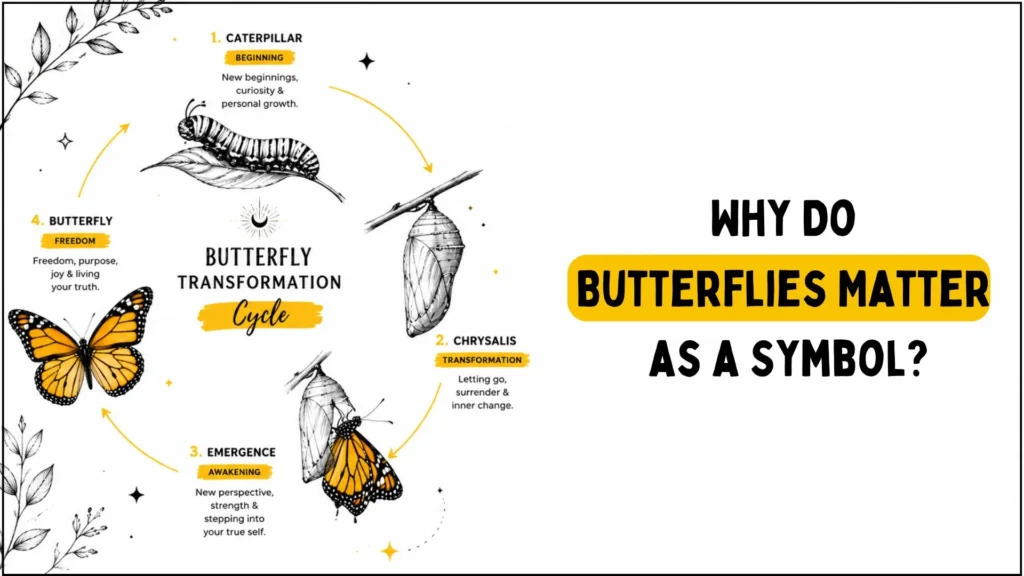
Butterflies matter symbolically because their life cycle mirrors one of the most universal human experiences: transformation.
First, a butterfly begins as a caterpillar, enters a dormant chrysalis stage, and emerges completely changed, a process that has made it a natural metaphor for personal growth for thousands of years.
Moreover, this life cycle resonates across cultures precisely because everyone experiences their own version of struggle, stillness, and renewal at some point.
In ancient Greece, the word for “butterfly” (psyche) was also the word for “soul,” and the Greeks often depicted the soul leaving the body as a butterfly.
In Mexican culture, monarch butterflies are closely tied to Día de los Muertos, since their annual migration coincides with the holiday, and many believe the butterflies carry the spirits of ancestors home.
In Chinese folklore, a pair of butterflies is a symbol of love and long life, while in some Native American traditions, butterflies represent change, joy, and color returning to the world after hardship.
Plus, the emotional significance of a sign often depends on personal context rather than culture alone. A butterfly appearing during a stressful week can feel like reassurance, while the same sighting during a joyful season might feel like confirmation.
This is why two people can see the exact same butterfly and walk away with two completely different meanings.
What Are the Spiritual Meanings of Repeatedly Seeing Butterflies?
Repeatedly seeing butterflies is spiritually interpreted as a sign of transformation, guidance, hope, or a message from a loved one who has passed, depending on the tradition.
“Repeated butterfly sightings are commonly interpreted as symbols of transformation, hope, and personal growth in many spiritual traditions.”
First, many people in the signs from the universe community believe recurring sightings appear during moments when someone is on the edge of a significant decision or shift, almost like gentle encouragement to keep going.
For example, someone actively working through spiritual awakening signs might interpret a butterfly landing on their hand as confirmation that they’re moving in the right direction.
In addition, some spiritual practitioners view butterflies as companions to angels or spirit guides, appearing at exactly the right moment to offer comfort.
That being said, “butterfly symbolism varies across cultures, but themes of renewal, change, and resilience appear consistently throughout history,” which suggests the core meaning stays fairly consistent even when the specific belief system changes.
Butterflies as Signs From the Universe
Believers in signs from the universe often describe butterflies as one of the most common “nudges” people report noticing during major transitions.
First, this belief typically isn’t about the butterfly itself being magical, but about the timing of the encounter feeling too specific to ignore.
For example, a person praying for clarity about a relationship might see a butterfly land directly in front of them minutes later and interpret that as an answer.
Why Do I Keep Seeing Butterflies After Someone Passed Away?
Seeing butterflies after a loved one’s death is often interpreted as a comforting sign of their continued presence, connection, or peace.
First, this belief is extremely common; a University of Nottingham survey of 1,603 bereaved people found that 98.6% reported sensing their deceased loved one at home, while driving, in a dream, or when ill – Source: University of Nottingham/University of York, 1995.
At the same time, more recent bereavement research on after-death communication (ADC) experiences estimates that 40 to 60% of bereaved adults report at least one ADC experience – Source: Farmers’ Almanac grief research summary, 2026, and butterflies are one of the signs most frequently mentioned in these accounts.
For example, a person might notice a butterfly circling their car on the anniversary of their mother’s death and feel an overwhelming sense that she is nearby.
Moreover, Pew Research Center found that 53% of U.S. adults say they have been visited by a dead family member in a dream or another form, with women reporting these experiences more often than men – Source: Pew Research Center, 2023.
As such, whether or not the butterfly itself is a “message,” the emotional comfort people find in these encounters is well documented and considered a normal, healthy part of grief.
That being said, grief researchers are careful to distinguish between comfort and proof. “There is no scientific evidence proving butterflies are supernatural messages, but many people find symbolic meaning in these experiences as part of personal reflection and spiritual practice.”
Plus, therapists refer to this ongoing connection as “continuing bonds,” a recognized and supportive part of the grieving process rather than something to be dismissed.
What Does Seeing Butterflies Mean During Spiritual Awakening?
Seeing butterflies during a spiritual awakening is generally interpreted as a symbol of internal transformation happening beneath the surface.
First, spiritual awakening is often described as a period of shedding old beliefs, habits, or identities, which maps closely onto the caterpillar-to-chrysalis-to-butterfly cycle.
For more on identifying this stage of growth, many readers cross-reference the broader spiritual awakening signs that tend to show up alongside butterfly encounters, such as vivid dreams, heightened intuition, or a pull toward solitude.
For example, someone who recently left a long-term job to pursue a completely different path might start noticing butterflies during meditation or quiet moments in nature.
In addition, this period is often accompanied by increased attention to manifestation signs and law of attraction signs, since people going through awakening tend to become more attuned to synchronicity in general. This heightened awareness ties directly into the psychological explanation covered next.
How Does Psychology Explain Repeated Butterfly Sightings?
Psychology explains repeated butterfly sightings through selective attention and a cognitive bias known as the frequency illusion. “Selective attention, also known as the frequency illusion, can make butterfly encounters seem more common after they become emotionally significant.”
First, once your brain flags butterflies as meaningful, whether due to grief, hope, or curiosity, it becomes more efficient at spotting them in your surroundings, even though the actual number of butterflies around you hasn’t changed.
Researchers call this the Baader-Meinhof phenomenon, and neuroscience research by Bunzeck and Duzel, published in the journal Neuron, found that the hippocampus and midbrain show heightened activation and dopamine release in response to novel stimuli — Source: Bunzeck & Duzel, Neuron, 2006.
This means the effect has a genuine biological basis rather than being purely imaginary. “According to psychological research on confirmation bias and the Reticular Activating System (RAS), people naturally notice patterns that align with their current thoughts, emotions, and expectations.”
Confirmation Bias and the Reticular Activating System
The Reticular Activating System (RAS) is a network in the brainstem that filters which sensory information reaches conscious awareness.
For example, once you decide to buy a certain car model, you suddenly notice that same car everywhere on the road, not because more people bought it, but because your RAS started prioritizing it.
The same mechanism applies to butterflies: once you start wondering about their meaning, your brain quietly begins flagging every butterfly-shaped object, image, or real sighting for your attention.
This meaning of synchronicity sits at the intersection of psychology and spirituality, since a psychological explanation doesn’t necessarily cancel out a spiritual one.
By understanding both sides, you can hold space for the emotional significance of a sighting while also recognizing why your brain might be primed to notice it more.
Butterfly Color Meanings: Spiritual Symbolism
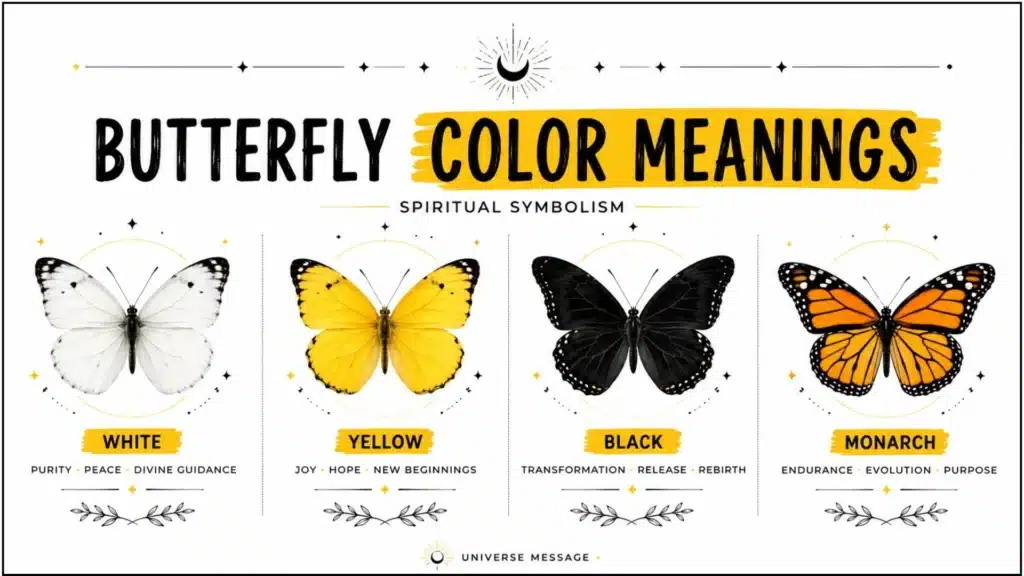
Yes, butterfly colors are commonly assigned different spiritual meanings, with each color tied to a distinct emotional or symbolic theme.
First, white butterflies are widely associated with peace, purity, and the presence of a departed loved one. Moreover, yellow butterflies are linked to hope, joy, and positive change, while black butterflies often represent transformation, letting go, or the end of a difficult chapter rather than anything negative.
| Butterfly Color | Common Spiritual Meaning | Frequently Associated With |
|---|---|---|
| White | Peace, purity, spiritual presence | After-death connection, comfort during grief |
| Yellow | Hope, joy, optimism | New beginnings, positive change |
| Black | Transformation, release | Endings, letting go, big change |
| Blue | Joy, communication, emotional healing | Clarity, self-expression |
| Orange (Monarch) | Endurance, resilience, migration/journey | Long-term goals, perseverance |
| Brown | Grounding, stability, practicality | Staying rooted during change |
For example, someone who spots a yellow butterfly right after making a difficult but hopeful decision might feel it reinforces that they made the right call.
In addition, monarch butterflies specifically carry an extra layer of meaning tied to endurance, since their multi-generational migration across thousands of miles has made them a global symbol of resilience. That said, can help make these distinctions easier to remember.
Can Butterfly Encounters Happen in Dreams, and Do They Mean Something Different?
Butterfly dreams are generally interpreted using the same transformation symbolism as real-life sightings, though dream context adds another layer of meaning.
First, dreaming about a butterfly landing on you is often read as a sign of accepting change gracefully, while dreaming about catching one may suggest trying to control an outcome you should instead let unfold naturally.
For example, someone anxious about an upcoming move might dream of butterflies escaping a jar, which could reflect a subconscious desire for freedom from a stressful situation.
At the same time, real-life sightings tend to carry more immediate, situational weight because they’re tied to a specific moment and environment.
As such, many people find it helpful to journal both dream and waking encounters separately, since journaling for spiritual growth can reveal whether a pattern is emotional (showing up in dreams) or environmental (showing up in daily life).
When Are Butterfly Sightings Simply a Coincidence?
Butterfly sightings are simply a coincidence when they align with predictable seasonal, geographic, or environmental patterns rather than personal life events.
First, butterflies are most active during warmer months, so seeing several in your garden in July is far less likely to carry deep symbolic weight than an unexpected sighting in the middle of winter.
For example, migratory monarch season in North America runs roughly from late summer through fall, meaning a sudden increase in sightings during that window is largely a matter of biology, not destiny.
It’s also worth noting that butterfly populations, while symbolically resilient, are under real ecological pressure.
A 2025 study published in the journal Science found that the total number of butterflies across 554 species in the U.S. dropped by 22% over the past two decades – Source: Science journal, 2025- and the Xerces Society recorded the second-lowest western monarch overwintering population on record, with only 9,119 butterflies counted in the 2024–2025 season – Source: Xerces Society, 2025.
Moreover, more recent counts show the population remains fragile, with the Xerces Society’s 2026 western monarch count recording just 12,260 butterflies across 249 sites, continuing the multi-year decline – Source: Xerces Society/National Wildlife Federation, 2026. Plus, if you live near a butterfly garden, wildflower field, or milkweed patch, frequent sightings are simply a byproduct of a healthy nearby habitat rather than a sign at all.
How Can You Interpret Butterfly Signs in Your Own Life?
You can interpret butterfly signs in your own life by paying attention to timing, emotion, and context rather than searching for one universal meaning.
First, ask yourself what was happening internally or externally at the moment of the sighting, since a butterfly appearing during a stressful phone call carries different weight than one seen on an ordinary walk.
“Personal interpretation is often more meaningful than universal symbolism because life circumstances influence how recurring signs are experienced.”
A Simple Reflection Framework
For example, try asking three questions after each sighting: What was I thinking about right before I noticed it? What emotion came up when I saw it? Does this connect to anything currently unresolved in my life? By working through these questions consistently, you can build a personal symbolism system that means more to you than any generic interpretation ever could.
Tools and Practical Ways to Track Butterfly Sightings

Tracking your butterfly encounters over time is the most practical way to figure out whether they follow a meaningful pattern.
First, a simple notes app or physical journal works well for logging the date, location, color, and your emotional state at the time of each sighting. “Keeping a journal of repeated butterfly sightings can help identify patterns between the encounters and important life events.”
You can start with a free tool like the Notes app on your phone or a basic Google Sheet, recording each sighting in a single row.
Moreover, several manifestation and mindfulness apps now include a general “signs and synchronicity” tracker, which can be useful if you’re also logging other symbols like feathers or repeating numbers alongside butterflies.
For a lower-tech option, some people prefer a printed journaling for spiritual growth worksheet with prompts already built in, which removes the friction of deciding what to write each time. Either way, the goal is the same: consistency over a few weeks or months will tell you far more than any single sighting ever could.
What Should You Do After Repeatedly Seeing Butterflies?
After repeatedly seeing butterflies, the best next step is to observe the pattern with curiosity rather than forcing a specific meaning onto it.
First, give yourself permission to sit with the experience without immediately deciding whether it’s spiritual or coincidental, since certainty isn’t required for the moment to still feel meaningful. For example, you might simply say to yourself, “I noticed this, and it felt significant,” without needing to resolve exactly why.
In addition, cross-reference your butterfly sightings with other symbols you’ve been noticing, since many people also report an increase in why do I keep seeing dragonflies, repeating numbers, or seeing feathers meaning during the same period.
This can help you trust your intuition more broadly, rather than fixating on one symbol in isolation. Finally, use the experience as a gentle prompt for reflection: what is changing in your life right now, and how do you feel about it?
Conclusion
Repeatedly seeing butterflies can be a spiritual sign, a psychological pattern, or simply a natural coincidence, and honestly, it doesn’t have to be only one of those things.
Whether you lean toward the symbolic meaning of transformation and connection, or the psychological explanation rooted in selective attention, both perspectives can coexist without canceling each other out.
The most valuable next step is simple: stay curious, keep a record of your experiences, and let your own life context guide the interpretation that feels right to you.
Frequently Asked Questions
1. Is seeing butterflies a good sign?
A. Seeing a butterfly is widely considered a good sign in most spiritual traditions, since butterflies are strongly associated with hope, renewal, and positive transformation rather than warning or danger.
2. Are butterflies signs from heaven?
A. Many people interpret butterflies as signs from heaven or a departed loved one, particularly after loss, though this belief is spiritual rather than scientifically verified.
3. What does the Bible say about butterflies?
A. Butterflies aren’t mentioned by name in the Bible, but many Christians draw a parallel between the butterfly’s transformation and biblical themes of resurrection, renewal, and new life.
4. What does it mean when butterflies land on you?
A. A butterfly landing directly on you is often interpreted as an especially strong sign of connection, luck, or confirmation, since it requires the butterfly to choose you specifically rather than simply passing by.
5. Can butterflies symbolize twin flames?
A. Yes, within twin flame communities, butterflies are sometimes seen as a symbol of the transformation both people undergo individually before or during their connection.
6. Why do butterflies appear during grief?
A. Butterflies often appear during grief because bereaved individuals become more emotionally attuned to symbols of continuity and hope, and because after-death communication experiences are a well-documented, common part of the grieving process.
7. Is repeatedly seeing butterflies a coincidence?
A. It can be, especially during warm-weather months or near gardens and wildflower fields, since butterfly activity naturally increases in those conditions regardless of personal meaning.
8. What color butterfly has the strongest symbolism?
A. White and monarch (orange) butterflies are often cited as carrying the strongest symbolism, representing spiritual presence and resilience respectively, though the “strongest” meaning ultimately depends on personal and cultural context.
Editorial & Affiliate Disclaimer: This content is for informational and educational purposes only and reflects a blend of spiritual, cultural, and psychological perspectives. It is not intended as medical, mental health, legal, financial, or professional advice. Always consult a qualified professional regarding your specific situation. This post may contain affiliate links, and we may earn a commission at no extra cost to you if you choose to purchase through them.

I’m Joe, the voice behind this blog. I write about signs, thoughts, and moments that don’t feel random. Simple things that somehow seem to carry a deeper meaning. This space is for anyone who feels there’s more to life than what we see on the surface. Through articles on spirituality, self-discovery, manifestation, and personal growth, I aim to help readers explore the messages, patterns, and connections that may be guiding their journey.